DS2

Tracy El-Rahi & Antoine Semaan

References:

See shocking footage of violent protests in Lebanon – CNN Video. (2020, April 29). Retrieved from https://edition.cnn.com/videos/world/2020/04/29/lebanon-middle-east-covid-19-coronavirus-protesters-clash-security-forces-karadsheh-intl-ldn-vpx.cnn

MTVLebanonNews. (2020, 11 May). محاولة اقتحام وزارة الاقتصاد [Video]. YouTube. https://www.youtube.com/watch?v=cnZJVk-tBtk

LBCI Lebanon News. (2020, 21 April). قطع الطريق عند مثلث خلدة من قبل أهالي وأصدقاء شهيد الثورة علاء أبو فخر  [Video]. Youtube. https://www.youtube.com/watch?v=X1fkw3Rga1A&feature=share
TE

Herman, E. S., & Chomsky, N. (1988). A Propaganda Model [read excerpts]. Excerpted from Manufacturing consent: The political economy of the mass media (1st ed.). New York, N.Y: Pantheon Books. Retrieved from: https://chomsky.info/consent01/

Khiabany, G. (2016). The Middle East. In: B. Birkinbine; G. Rodrigi and J. Wasko (eds.)Global Media Giants. New York: Routledge. Retrieved from: http://research.gold.ac.uk/18559/1/The%20Middle%20East.pdf

Moeller, S. (1999). Four Habits of International News Reporting (read pages 1-6 only): In Compassion fatigue. London: Routledge. https://frameworksinstitute.org/assets/files/PDF_GII/four_habits_of_news_reporting.pd f  

Ristovska, S. (2016). Strategic witnessing in an age of video activism. Media, Culture & Society, 38(7): 1034-1047. Retrieved from https://doi.org/10.1177/0163443716635866
Final Blog Post

Media literacy defines one’s capacity to understand, interpret, and use the information received by the media through the different methods of communication.

Media literacy enables one’s interpretation of media texts to awaken their attention on the various aspects of the daily life that the media affects, such as the social and political aspects (Hoechsmann, M., and Poyntz, S.R., 2012). From the television to an advertisement, a radio talk show, and even a video game: media comes in many forms, and is all around us. It is a representation of messages transferred that takes into account a production, a language, a sender, a targeted audience and information in any form it may be presented (Hoechsmann, M., and Poyntz, S.R., 2012). Media literacy is highly subjective to the different histories, nationalities and races present across the world. Media education is increasingly becoming a crucial element of our lives, as it helps gain awareness of how the media shapes and influences elements of our lives.

In fact, the media is influenced by the political economy, by its source, by capitalism, and one thing I for sure learned in this course is that not everything we see or hear is what it seems. I have learned that supporting smaller sources of free media is crucial for the freedom of speech of people especially against capitalism, and the government’s manipulation of us. I will be more aware of the sources of the media, as every aspect of it is calculated and aims to manipulate your mind in a way or another. I will also do my part in spreading as much awareness as possible regarding media literacy and the importance of educating the youth on the media they are constantly exposed to.

Hoechsmann, M., and Poyntz, S.R. (2012) What is Media Literacy? In Media literacies: a critical introduction  (pp. 1-16). UK. Wiley-Blackwell Publishing Ltd.9781405186117

In class exercise 4 – sound

Continuous and repetitive sounds: cars passing, wind blowing

Repetitive: constructions

Unique sounds: tires screeching on the road

Machine and technological: car sounds (honking, tires screeching), constructing machine

Human made: –

Moving: cars

Close: cars near my house, the wind blowing, construction near my house

Far: cars a bit farther away, my mom calling my brother

Step 7: 1) I can hear them more clearly, that was when I had noticed how strong the constructing machine sounded. I also could hear my own sounds more (breathing, saliva)

2) New sounds: Perhaps the constructing machine and the cars (as they have evolved a lot since)

3)Old sounds that have disappeared: -Bombings -Frogs quacking in the lake -“Ka3ek” seller (according to my parents)

4)Loudest moment: 7:55-9:55

Fake News in the Media

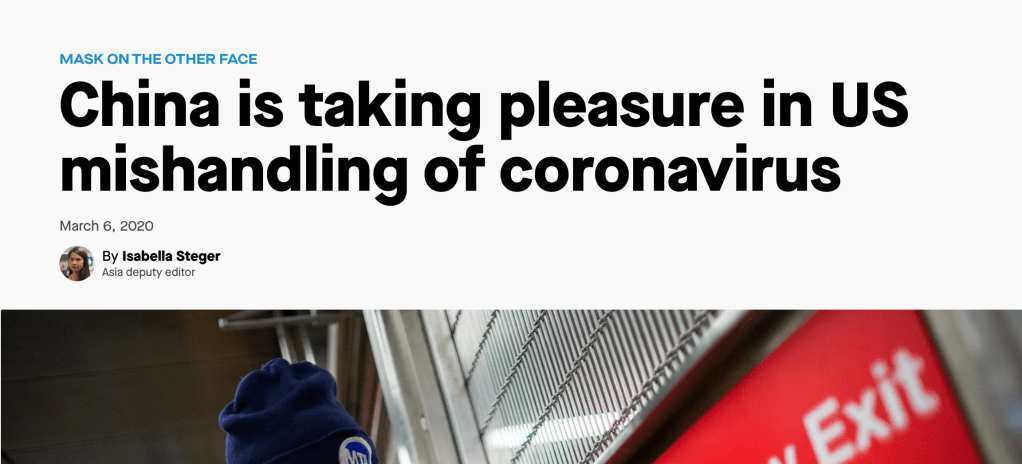
The World is now facing a Pandemic virus, the Corona virus that has been causing chaos in our lives, and unfortunately is taking many’s lives. In an article entitled China is taking pleasure in US mishandling of coronavirus, the news listed is fake on many levels and misleading to someone unaware of the credibility of the news. I believe this news is a misinformation, as the author might be convinced that it is true news based on assumptions, however, the information is fake as it doesn’t have any valid proof in the article. No one was cited in the article that proves the point made in the headlines, rather it is clear that the news listed is an interpretation of a few lines spoken by the Chinese government.

In order to avoid fake news, our society needs to adopt a new type of a news sharing system by supervising online articles sharing news with the help of critical media, which can be achieved with the help of media organizations following rules and policies when sharing the news. Policies could include media supervision on different platforms, as well as the inability to post an article without credible sources.

https://www.google.com/amp/s/qz.com/1813181/china-is-taking-pleasure-in-us-mishandling-of-coronavirus/amp/

Zapatistas and Intifada

The Zapatistas are a brave group of people that rebelled against oppression and colonialism and capitalism. They produce their own media online, in which they accuse their oppression of freedom online. They also aimed to fight the false accusations they were being faced with online by the people in power and the present of Mexico. The Zapatistas gained worldwide support by people who saw their intentions rightfully so (Pagett, 2017).

On the other hand, in Palestine, the structural restraints of the internet activism are refraining Palestinian communities from defending themselves online against the Israeli government following its resort to “cyber-colonialism”. This unfortunately allows colonialism to even go against the freedom of speech of Palestinians on the Internet. (Tawil-Souri & Aouragh, 2014).

Padgett, R. (2017, February 25). Radical Legacy of the Zapatista’s Media Strategy.
Intifada! Retrieved from: http://www.svllywood.com/intifadaessays/radicalmedia

Tawil-Souri, H., and Aouragh, M. (2014). Intifada 3.0? Cyber colonialism and Palestinian
resistance. The Arab Studies Journal, 22(1): 102-133 (read excerpts pp. 102-106, 119-126of PDF). Retrieved from:http://www.arabstudiesjournal.org/store/p390/Intifada_3.0%3F_Cyber_Colonialism_and_Palestinian_Resistance.html

Class activity: example of alternative and independent media

During the Lebanese revolution of October 17 2019, Oleksandra El-Zahran stepped up and started sharing independent accurate news on her Instagram page, and later on created the page Bedak Tghayir which is a politically unaffiliated and independent student election campaign at the Lebanese American University. Whether it is on her page or on her other page Bedak tghayir on Instagram, she shares news of whatever is happening in Lebanon independently from the government and the law or anyone in power.

Although Olleksandra’s pages are independent and free to share whatever they want, they are still limited as alternative and independent news media. Instagram is owned by the states, and the internet in our country is in the hands of the government, therefore our government has the power to take down her media outlet at anytime. Her followers are anti-government people in Lebanon that are fighting for a brighter future for our country, and her news is accurate, un-bias, and community oriented, which reinforces her supporters and her audience.

Forde, S. (2011). Chapter 1: Understanding alternative and ‘independent’ journalism
[read excerpts]. In Challenging the News: The Journalism of Alternative and Community
Media. New York: Palgrave Macmillan. Retrieved from:
https://www.macmillanihe.com/resources/sample-chapters/9780230243569_sample.pdf

Independent and alternative media

Independent and alternative media are forms of media that are operating without government supervision, rather a free media platform, to some extent.

Even though they own their content and they are free to do it however they want, these media outlets are limited by the internet, as they do not own the internet and therefore their websites. Therefore in some ways, independent and alternative media are limited as the government and the military are the ones that own the internet.

Although some people may refer to such media as “unprofessional”, however its widespread use make it what it is. People refer to such media for news and information that is democratized (Forde, 2011).

Forde, S. (2011). Chapter 1: Understanding alternative and ‘independent’ journalism
[read excerpts]. In Challenging the News: The Journalism of Alternative and Community
Media. New York: Palgrave Macmillan. Retrieved from:
https://www.macmillanihe.com/resources/sample-chapters/9780230243569_sample.pdf

Class activity: Prison Radio

Prison radio is a radio station that is independent and non-profit oriented. It fights to produce news that does not follow a private owner or colonialism and capitalism. Its ultimate goal is based on the core concept of sharing information within the community. Prison radio incorporates Dunifer’s concept of free radio and Fanon’s active community concept that revolves around a community of people that listen and participate in being part of the radio channel and control the station themselves. They’re free of any domination.

An example of a prison radio channel would be Souverains Anonymes from Canada that directly involve prisoners to live broadcast news from the prison (Abu Jammal), as well as Beyond the bars from Australia. These radio stations involve the prison community to speak up and share news without being obliged to modify their speech by authority. It is a free community and a safe space.

References


Fanon, F. (1994). This is the Voice of Algeria [read excerpts]. In: Fanon, F. (ed.), A Dying
Colonialism, trans. H. Chevalier. New York: Grove Press. Retrieved from:
http://www.campusincamps.ps/wp-content/uploads/2015/10/fanon-this-is-the-voice-ofalgeria.pdf


Dunifer, S. (2010). Latitudes of Rebellion: Free Radio in an International Context [read
excerpts]. In Langlois, A., Sakolsky, R., and van der Zon, M. (Eds.) Islands of Resistance:
Pirate Radio in Canada. Vancouver: News Star Books. Retrieved from:
http://www.newstarbooks.com/pdfs/books/9781554200504-Resistance-web.pdf

Abu-Jamal, M. (2013). Media matters: Radio in prisons. Mumia Abu-Jamal’s Radio Essays.
[Podcast Audio]. Retrieved from http://mumiapodcast.libsyn.com/media-matters

Design a site like this with WordPress.com
Get started