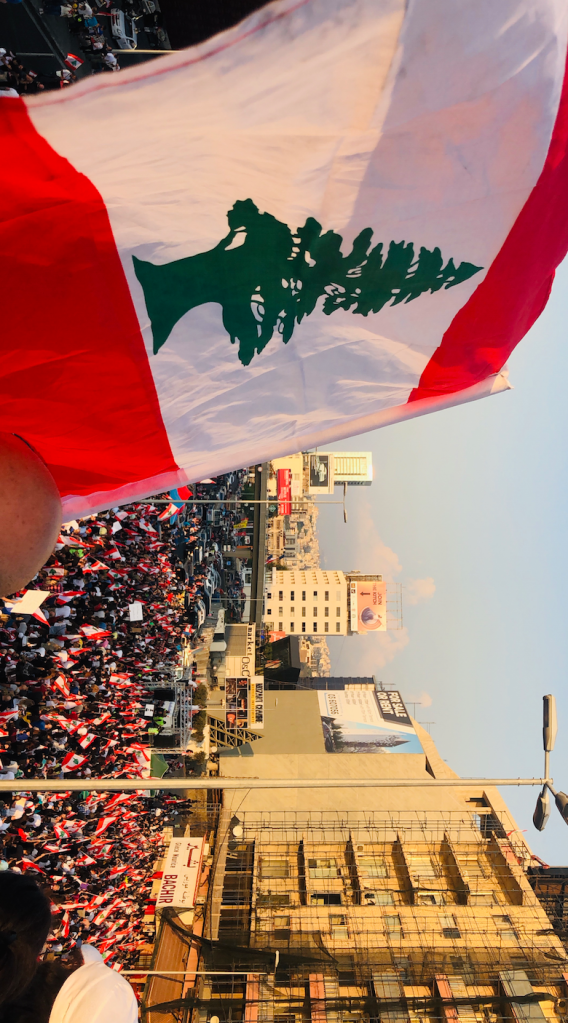
Resisting the power of colonialism and capitalism over the media

The station of The voice of Algeria resists the power of colonialism over the media. Even though the ownership by a Western country causes restraint and makes it be part of the colonial world.

The fight for liberation of The voice of Algeria is difficult because of the colonialism aspect of things however, as indicated in the article by Fanon, the political economy of the media is what helped fight against colonialism in the media. The voice of Algeria’s fight for the escape from the total ownership by the occupier was a call to every Algerian person who’s identity felt lost at the news displayed on the radio station.

Algerians would struggle listening to the stations in the first place, and would go around trying to get a working station. In fact, the French were putting down the access to the stations of Algerians. Therefore, the strong community wanted to be part of the network (Fanon) and joined the news given by Algerians to Algerians by The voice of Algeria, which stood up against every colonial occupier against the Algerians.

Free Radio are also radios that go against colonialism and capitalism. They are unlicensed and go against licensing and therefore against every aspect of occupiers dominating the programing on the radio or any media of their own nation. They are not channels for profit, but rather a community that wants its radio station to give them news that are un-bias and unedited. Every member of the community would volunteer to help broadcast the news.

References


Fanon, F. (1994). This is the Voice of Algeria [read excerpts]. In: Fanon, F. (ed.), A Dying
Colonialism, trans. H. Chevalier. New York: Grove Press. Retrieved from
http://www.campusincamps.ps/wp-content/uploads/2015/10/fanon-this-is-the-voice-ofalgeria.pdf

Dunifer, S. (2010). Latitudes of Rebellion: Free Radio in an International Context [read
excerpts]. In Langlois, A., Sakolsky, R., and van der Zon, M. (Eds.) Islands of Resistance:
Pirate Radio in Canada. Vancouver: News Star Books. Retrieved from:
http://www.newstarbooks.com/pdfs/books/9781554200504-Resistance-web.pdf
Internet live stats and digital surveillance

Internet live stats say a lot about our digital surveillance: the internet knows way too much about us… Its insanely accurate, and knows by the millisecond when someone uploaded or posted anything. Also, a lot of people are on the internet every second, meaning the internet can track us all down at any moment of everyday via our internet activity.

In fact, via media consolidation, allows the owners of media to control the mass media, along with our private information, our locations and our contacts. The problem of surveillance based on media consolidation as well as media concentration is major. We are depending on the internet in so many different ways and we are severely unaware of how much the internet knows about us.

There needs to be changes in what information is legal to be owned by the internet and the owners of these numerous media platforms that mostly all of the world has access to and uses on a daily basis. The numbers do not lie, a big number of our planet is unaware of the violation of privacy that we face constantly, myself included. We need more activism to impose policies regarding the information the internet (Facebook and more platforms) can have access to and can’t, as this problem is threatening and unethical. Activism could go from revolts, to general awareness to those around you and your family members.

https://www.internetlivestats.com/

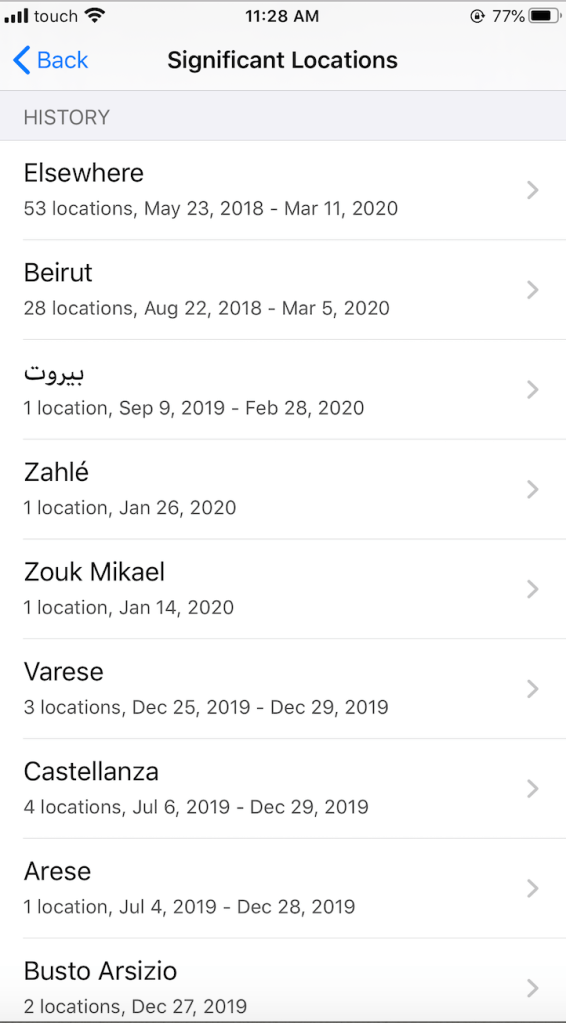
Digital Shadow and surveillance

Digital shadow and surveillance is wickedly accurate and legit. Digital shadow allows your phone to track down your location every day everywhere you take your phone to. My phone knows where I am at, in which country, at what time, and when. Although I can think of a couple situations when this could be practical maybe… The rest is just plain weird and creepy… I did not know that my location was turned on. Moreover, the location times how long you stayed at every location. If your phone got lost, people would have access to everything about you through your phone even where you spend most of your time… This is an insane lack of privacy, security, and is very dangerous and threatening to our general safety, as it really has every proof of where we spend our time.

The political economy of media shaping Lebanese television programming

Unfortunately, the political economy of media shapes the entire television programming in Lebanon. Television in Lebanon is first very subjective based on the ownership of the media platform. That being said, the media is shaped by the ownership of the platform (Fuchs). The media platform of OTV Lebanon is owned by the free patriotic movement in Lebanon, resulting in a publication of news that is completely subjective to their movement. As mentioned in the video Fallen Television (Majzoub, 2015), OTV’s ownership by this political movement causes them to shape media in their way. An example would be their constant propaganda against another opposing political movement on the TV channel to be posted.

Another way the political economy shapes the media would be through the concept of a Fuchs of capitalist communications. Tv channel are programmed in a way to please the audience and attract more viewers for economical purposes. The tv channel Al Jadeed once posted a famous Lebanese singer that is provocative in the way she behaves and creates, singing about deputies in Lebanon as seen in the video by Majzoub (2015). That allows us to see that Tv programs in Lebanon are indeed shaped by what attracts viewers and a wider audience, in order to benefit on the economical side of things.

The tv program Teleliban is economically unviable, meaning it is unstable financially (Khiabany). In fact, its numerous accusations and critiquing vis-a-vis its late news reporting and unreliable sources to cause its financial instability. The government had to save the Tv channel economically multiple times. The complete neglecting of the broadcasting of their news as well as their shows, has resulted in its social and economical state.

Tv programming in Lebanon has relied on sectarian publication of news and shows, causing its audience to feel the lack of trustworthiness with its media outlets, and resulting in a subjective and corrupted type of news publishing in Lebanon.

Majzoub, M. (2015) Fallen Television. Tele Liban. Retrieved from:
https://www.youtube.com/watch?v=l2ZHGeCLLqA&t=1681s

Fuchs, C. (2016). Introduction, read pp. 1-5 only. In Reading Marx In The Information Age:
A Media and Communication Studies Perspective on Capital Volume 1. New York:
Routledge. Retrieved from: http://fuchs.uti.at/wp-content/uploads/introduction.pdf

Khiabany, G. (2016). The Middle East. In: B. Birkinbine; G. Rodrigi and J. Wasko (eds.)
Global Media Giants. New York: Routledge. Retrieved from:
http://research.gold.ac.uk/18559/1/The%20Middle%20East.pdf

Facebook and surveillance

Facebook exposes us to many forms of surveillance. One of them being commercial surveillance. In fact, Facebook uses us for commercial purposes, by allowing advertisements to pop up. Facebook gathers information about us, and then manufactures the ads that pop up on our screens according to our lifestyle and likings.

Next up, Facebook uses surveillance for political reasons. Governments can manipulate citizen’s behavior and preferences, and keep track of the general statements made by each one of us that end up getting posted.

Lastly Facebook uses surveillance of peers and states. What we post on Facebook is carefully selected and observed. It also manipulates the way we see posts on our feed, depending on our preferences.

Vaidhyanathan, S. (2018, August 18). Antisocial Media How Facebook Disconnects Us and
Undermines Democracy. Indian Cultural Forum. Retrieved from:
http://indianculturalforum.in/2018/08/18/anti-social-media-how-facebook-disconnectsus-and-undermines-democracy/

Surveillance-industrial complex

According to Ball and Snider (2013), the surveillance-industrial complex is the expansion of surveillance in the every day lives of people through military means. As Hache and Snider defend, surveillance-industrial complex is essential for human right defenders and activists. Surveillance can help track down and limit harassers, and controlling data on the internet.

Ball, K., and Snider, L. (2013). The surveillance-industrial complex: towards a political
economy of surveillance? (excerpt, read p. 1-5 only, until “the volume” heading). In K.
Ball and L. Snider (eds.), The Surveillance-Industrial Complex: A political economy of
surveillance. Retrieved from: https://www.book2look.com/embed/9781136206979

Hache, A., and Jansen, F. (2018, July 9). Privacy, Surveillance and Data Tracking: Why
Does it Matter for Human Rights Defenders? In Free media: issues, challenges and
proposals (online publication). Retrieved from: https://www.ritimo.org/PrivacySurveillance-and-Data-Tracking-Why-Does-it-Matter-for-Human-Rights

Media ownership in the Middle East

In the Middle East, there is a direct correlation between media ownership and politics. In fact, the leading media firms are backed by political movements and parties (Khiabany, 2016). The feeling of the cultural collectiveness in the Arab world allows the sense of correlation between political parties and media ownership, as they are the ones dominating the news published to the people.

An example of media ownership and political parties would be the Lebanese Channel “OTV” owned by a political party in Lebanon. Their portrayal of the news is completely subjective to them. They do not fairly share the news, rather they in a way that fits their own version of the news, while keeping their political party intact.

Militainment refers to entertainment that deals with military themes. For instance, Call of Duty video game franchise is about using military exercises and events in a video game format.

Khiabany, G. (2016). The Middle East. In: B. Birkinbine; G. Rodrigi and J. Wasko (eds.)
Global Media Giants. New York: Routledge. Retrieved from:
http://research.gold.ac.uk/18559/1/The%20Middle%20East.pdf

Andersen, R., and Mirrlees, T. (2014). Introduction: Media, Technology, and the Culture
of Militarism: Watching, Playing and Resisting the War Society. Democratic Communiqué,
26(2): 1-21. Retrieved from: http://journals.fcla.edu/demcom/article/view/83940/80844

Capitalism

Capitalism: my definition of Capitalism is how private owners make up the economy of the country, which gives them huge political and economic importance. This also inherently breeds social classes where the elite owners, businessmen and companies have huge political and economic influence on societies.

Capitalist communication: Private owners and people from the upper class tend to benefit from the lower classes through media, and advertisements.

References:

Fuchs, C. (2016). Introduction, read pp. 1-5 only. In Reading Marx In The Information Age:
A Media and Communication Studies Perspective on Capital Volume 1. New York:
Routledge. Retrieved from: http://fuchs.uti.at/wp-content/uploads/introduction.pdf


Berger, Arthur Asa (2019). Media analysis techniques (read excerpts from Chapter 2
“Marxist Analysis”). Newbury Park: Sage Publications. Retrieved from:
https://us.sagepub.com/sites/default/files/upmbinaries/88706_Chapter_2_Marxist_Analysis.pdf

Media discourse on sexuality in Lebanon

Media discourse on sexuality evolved through time in Lebanon. The changes did not instantly happen, but rather they slowly built throughout time “within Lebanese media, within larger socio-political structures, and as a result of progressive activist efforts” (Mandour, 2013).

Although the improvements in this side of the media in Lebanon have just begun, Cinema Plaza’s case helped accentuate the numerous efforts of the activists in Lebanon regarding sexual discourse and create a result. In fact, the homophobia backlash that the news reporting media received after the Cinema Plaza case, in which men were assigned to be criminals because of their sexuality, allowed for people to spread the word and build an army against the media outlet. (Mandour, 2013)

In the Cinema Plaza case, the people and activists were the only ones providing discourse; a language of power that aimed to talk about the homophobic habits in Lebanon. Whereas in 2013, the Dekwaneh case showed some improvements since the people and some media were talking about the homophobic habits of the media.

References:

Mandour, S. (2013). Potential Change in Media Discourse on Sexuality in Lebanon:
“Cinema Plaza” and Beyond [Reuters Institute Fellow’s Paper]. Retrieved from:
https://reutersinstitute.politics.ox.ac.uk/our-research/potential-change-media-discoursesexuality-lebanon-cinema-plaza-and-beyond

Design a site like this with WordPress.com
Get started